
Educating for human aliveness
A vision for flourishing in the future: rethinking education for the age of intelligence

In an age where AI is becoming as transformative as the internet was in the early 21st century and the computer before that, we face a critical question:
What does it mean to be a thriving, flourishing human being, and how might our educational systems rise to this moment?
The computer brought us calculation speed and automation. The internet brought global connection and instant access to information. The recent leaps in AI, from generative models to reasoning agents, mark a new shift in how we engage with knowledge, tools, and each other.
We can see early outlines of what AI might bring. On one hand, it could radically enhance our intelligence and creativity, ushering in a new era of human flourishing. On the other, we could hyper-fixate on boosting the efficiency of existing systems, generating unprecedented productivity gains without necessarily making us wiser, kinder, or more alive. The outcome is not fixed, and it will be shaped by what we choose to build.
Left to the market alone, the path will likely tilt toward productivity and profit. But what if we asked a different question: how might we use this moment to build systems that help us flourish and thrive? And if we were to start anywhere, shouldn’t it be the educational system — the one already tasked with nurturing the future?
The legacy we inherited: schools shaped by another era
A model shaped on industrialization
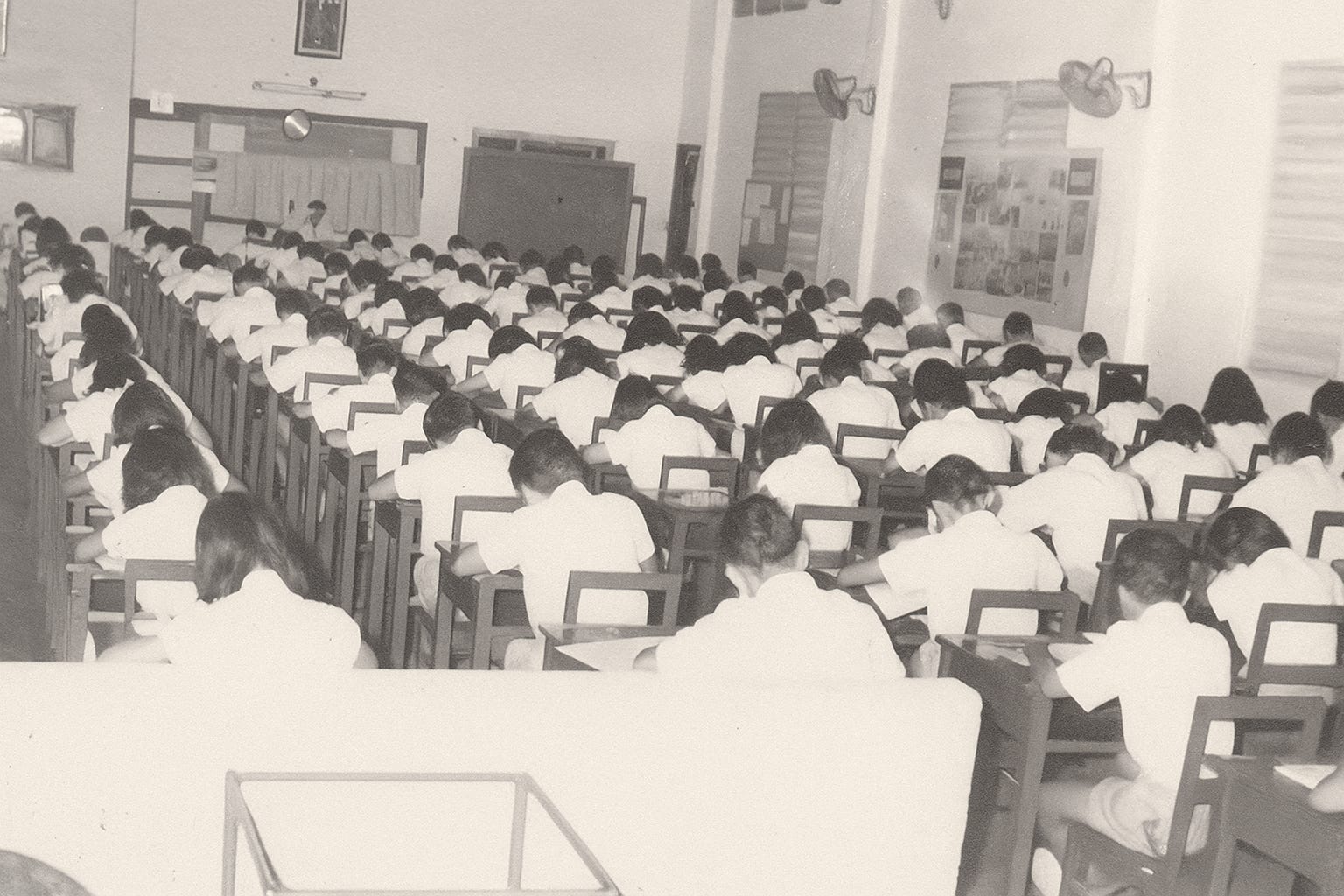
Modern schooling is a product of the 19th century, shaped by industrialization and urbanization. Before that, small one-room schoolhouses taught children of all ages in rural settings. As cities grew and populations swelled, we needed to educate far more children at once. We borrowed the Prussian model, built systems for scale, and focused on punctuality, discipline, and compliance, traits ideal for factory workers, military, and orderly citizens. Education was as much about social control as it was about learning.
Singapore’s context
Singapore’s schools have evolved from different historical, cultural and religious contexts, but similarly reflected an industrial-style focus on measurable skills. Discipline and order were high priorities, and schooling also served other aims like nation building and moral education. Schools were heavily centralized and geared toward workforce needs, with tight control over teaching and testing.
That said, the system has evolved away from its industrial roots. Streaming (introduced in 1979) and the Gifted Education Programme (introduced in 1984) aimed to offer more flexible, tailored learning, moving beyond one-size-fits-all models. But over time, these pathways became rigid and deterministic, often locking students in too early. Reforms like subject-based banding helped to soften that. Likewise, the introduction of 21st Century Competencies in 2010 marked a shift toward broader human development and greater emphasis on soft skills.
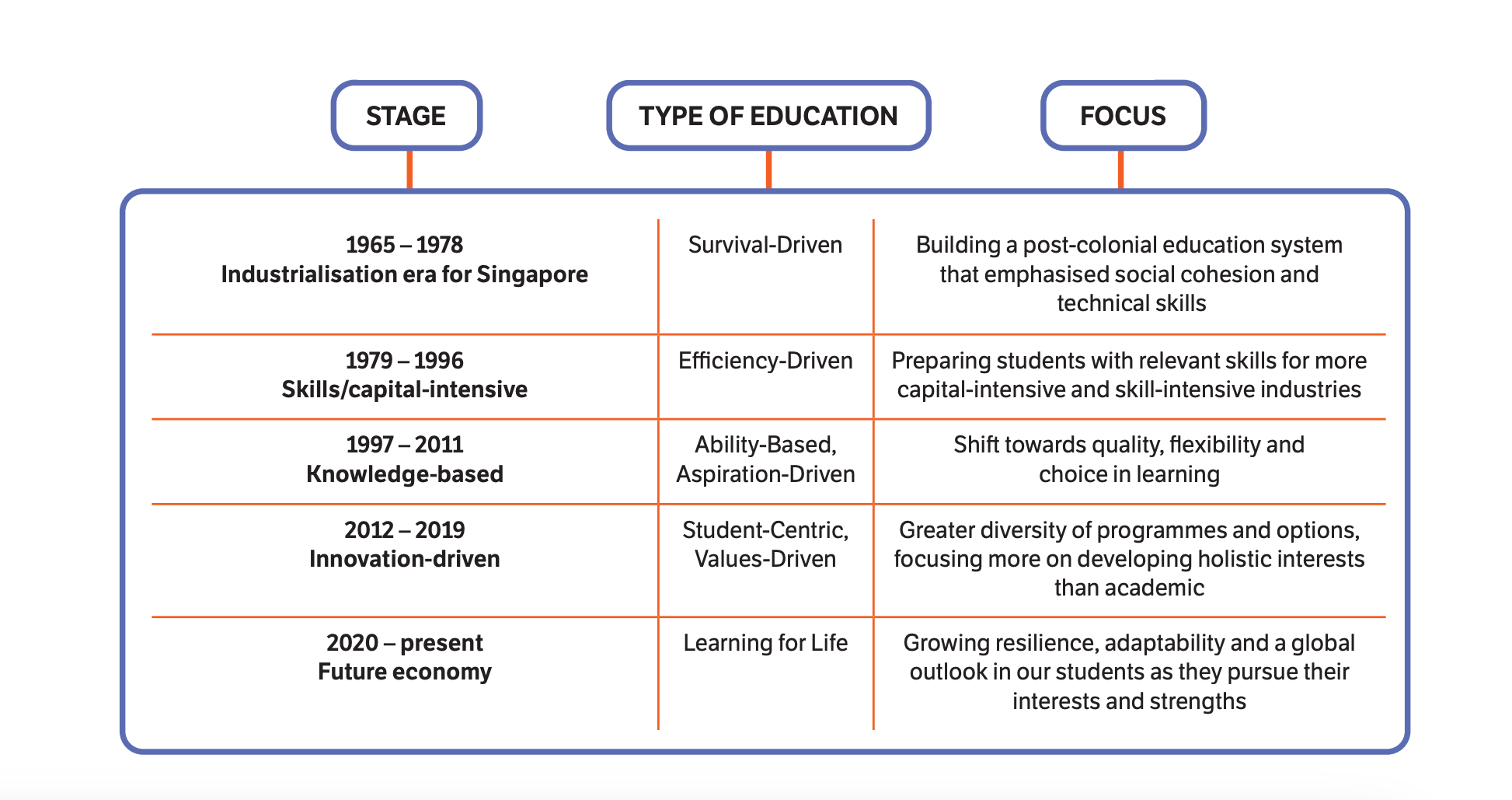
In broad strokes, our system has generally moved toward being more flexible, more holistic, and more centered on providing the best for every child’s individual needs. Students that are more academically inclined continue to thrive in our system today, and more opportunities are being created for those inclined otherwise.
Still, for a giant, complex system that is by and large working well, change tends to come in small steps.
A new brief for a different time
In pursuit of aliveness
What if, instead of merely updating the system to meet new demands, we asked what the deeper purpose of education should be now? What if schooling was not just about preparation for work or life, but about cultivating thriving, flourishing, and aliveness?

Thriving, flourishing, and aliveness can feel hard to define. But most of us have glimpsed them, in moments of deep presence and intrinsic motivation, or in people who move through life with purpose, clarity, and alignment. While they may also be conventionally successful, specialists or multi-hyphenates, excelling in their pursuits and materially secure, what stands out is their sense of joy, health, integrity, love, and being loved. Aliveness resists being reduced to metrics. Still, the Harvard Human Flourishing Program offers a useful starting point to define it, with five dimensions: happiness, health, meaning, character, and relationships.
What we learn when we learn
When we break down what we learn when we learn, it boils down to four core elements: knowledge, skills, attitudes, and identity. Knowledge helps us understand the world, e.g. the academic content and concepts we acquire through curriculum. Skills allow us to act on that knowledge, e.g. critical thinking or communicating effectively. Attitudes shape how we approach the world, e.g. "I am curious to explore the unknown." And identity is about how we see ourselves, e.g. "I am resilient," "I am a kind person."
We need all four elements to thrive and lead the vibrant lives we deserve. They shape how we define the impact we want to have on ourselves and others, and whether we feel empowered to pursue it.
Today, education is top-heavy. We focus on knowledge and skills, while hoping that attitudes and identity somehow fall into place. That may have made sense in a world where information was scarce and predictable. But in an era of instant information and increasingly capable AI, that model feels outdated.
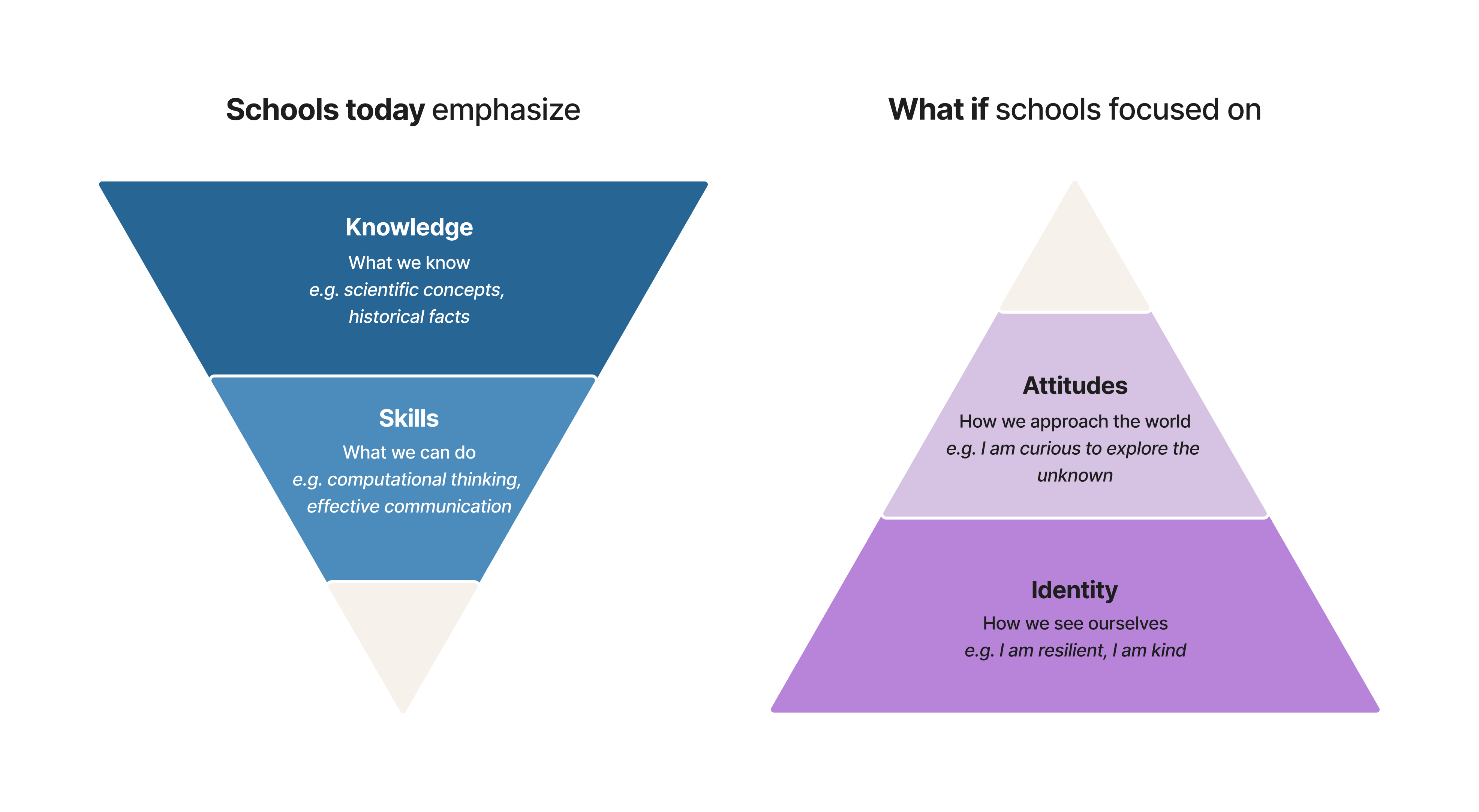
What if we made a bold shift, not away from knowledge and skills, but toward placing equal or greater weight on nurturing identity and attitude? What if schools worked in partnership with homes and communities, rather than separating the two? What would we design for a generation of AI-native children, those who speak to ChatGPT as naturally as they do to adults?
The identities and attitudes that matter now
If we hope for a future where humans flourish in harmony with technology, we will need to cultivate what is most deeply human.
Here is one possible starting point:
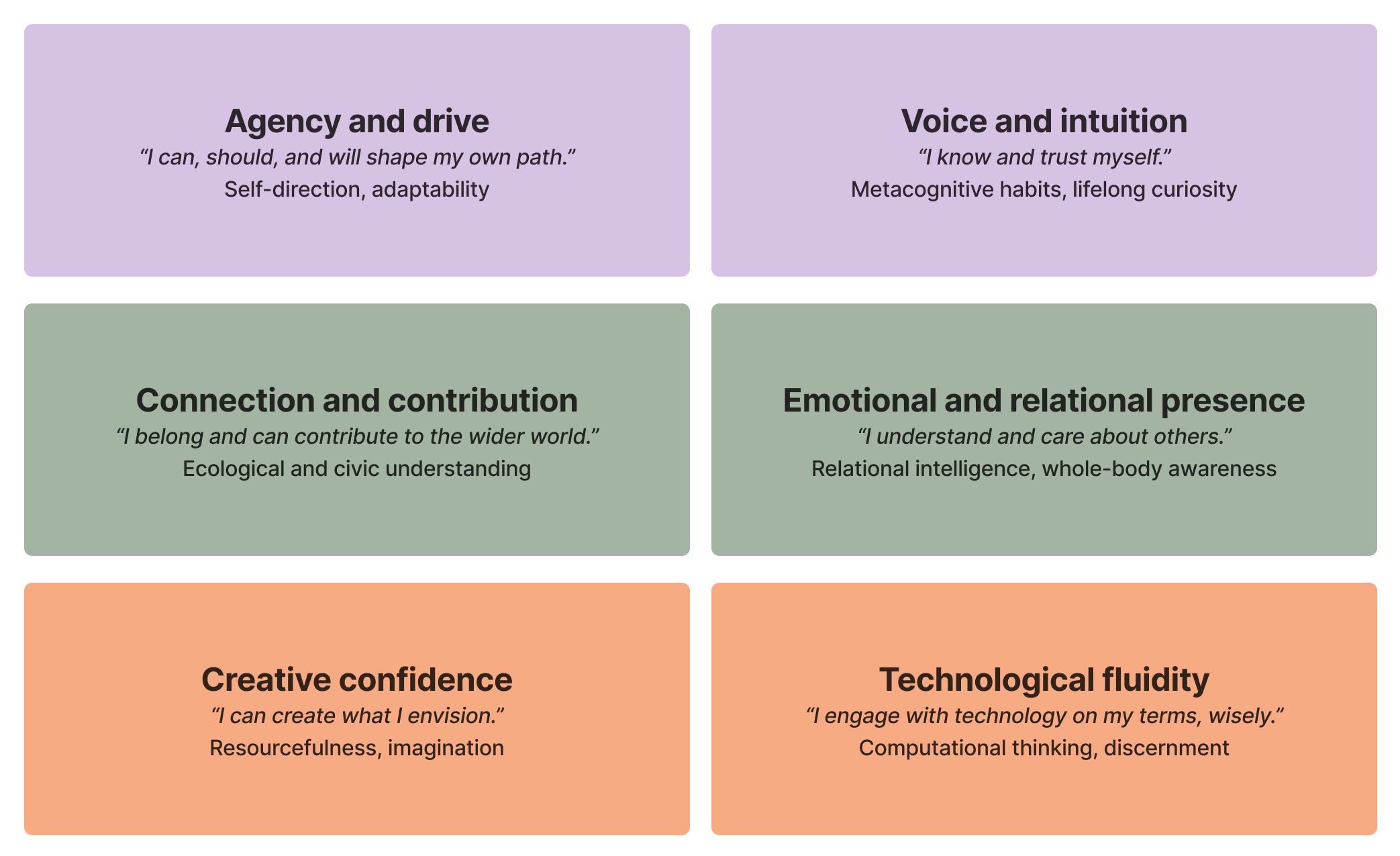
First, at the very core, is a sense of agency and drive.
“I can, should, and will shape my own path.”
This belief is foundational to everything else, because without it, we are subject to the whims of technological change, economic demands, and societal pressure, mere gears in a machine. Each generation now enters a world that looks vastly different by the time they finish school. Where even the rate of change is accelerating, it is easy to feel helpless, powerless even. In this context, the capacity and willingness to fully inhabit our unique selves become ever more critical. A competency crucial to developing this identity is self-direction: the ability to manage one’s own learning and work, and adapt to challenges with resilience and purpose.
Second, and very much related to the first, is an understanding in one’s own voice and intuition.
“I know and trust myself.”
AI can do much of the intellectual work that people are being paid for, and we tend to see that as a threat. Instead, can we see it as an opportunity, one that opens up a world where people are free to ask, what do I really want to do instead, and who do I really want to be? People will need to truly understand their own values, preferences, and interests to live in alignment with them. Corresponding competencies include self-understanding, metacognitive habits, and lifelong curiosity.
Third, is a sense of connection and contribution to the wider world.
“I belong and can contribute to the wider world.”
In an age where AI systems optimize for efficiency, personalization, and individual gain, it becomes even more essential for humans to stay anchored in something larger than themselves: ecosystems, communities, and generations. Through nurturing this broader awareness, individuals can find deeper purpose while cultivating humility and a spirit of service. Competencies here include ecological and civic understanding.
Fourth, is a sense of emotional and relational presence.
“I understand and care about others.”
Connection is the lifeblood of human flourishing: our ability to be seen, to belong, to love, and to build meaningful relationships. In a world increasingly shaped by synthetic communication, our capacity to listen with depth, to read emotional nuance, and to stay attuned to ourselves and others is not a luxury but a necessity. Competencies here include relational intelligence and whole-body awareness.
Fifth, is a sense of creative confidence.
“I can create what I envision.”
As generative tools grow more powerful, human creativity becomes not less important, but more sacred. To flourish is to bring something uniquely human into the world, shaped by one’s experiences, values, and voice. In this era, creative confidence means more than producing something novel or artistic — it is believing that your ideas, your vision, your story matter. It is the act of turning thought into form with intention and care, even in ambiguous situations. It is what ensures that technology serves our humanity, rather than replaces it.
Sixth, is a sense of technological fluidity.
“I engage with technology on my terms, wisely.”
This means being not just comfortable with AI, but developing a healthy relationship with it, understanding what it can and cannot do for us. As AI becomes more embedded in everyday decisions, having the discernment to use technology with intention, not compulsion, becomes key. It’s both about being adept at utilizing the powers available to us to the fullest, and about not allowing them to replace human depth, attention, and truth.
But is this realistic, and how do we build it?
Let’s pause to consider three possible critiques.
Critique 1: Too idealistic and not pragmatic!
Society still needs people playing important functions, such as doctors, accountants, bus drivers. We cannot have everyone abandon responsibility and pursue their interests with wild abandon. That’s true.
But thriving isn’t about abandoning necessary roles. It’s about entering them with purpose, clarity, and agency. When individuals know themselves and believe their work and life matter, they tend to be more committed, resilient, and ethical.
Nor does thriving doesn’t mean compromising on rigor. In fact, it often involves pursuing meaningful interests with depth and excellence — pursuits that may require, or be enriched by, strong academic understanding. Rather than sidelining knowledge and skills, the question is: how might our well-known academic rigor coexist with deep inner development?
Flourishing isn’t just about choosing the “right” job or de-centering excellence; it’s about living with intention across all aspects of life: relationships, community, creativity, rest. Flourishing doesn’t mean everyone becomes an artist or surfer. It’s about building a society where people are not just productive, but fully and meaningfully alive.
Critique 2: These may not be the “right” identities or attitudes.
We cannot predict the future, so this isn’t a “right” or final list. That’s completely valid. But rather than hiding behind that uncertainty, this opinionated perspective is intended to spark constructive debate. This list is by no means definitive, so I’d love to hear from you: What else do you think we need? What should be emphasized more or less?
Critique 3: What’s the implementation plan?
Rather than offering a complete blueprint, this is a working starting point, meant to be tested, stretched, and built upon. To bring this to life, here are some questions to guide constructive exploration:
What kinds of learning experiences or environments could embody this vision?
How do we integrate academic rigor with deeper human development?
How might we tap into Singapore’s passionate educators, vibrant communities, and forward-thinking parents to drive this forward?
How can AI support and enable these shifts?
What prototypes could we start building now?
These are the questions I hope to explore and prototype over the next ten weeks. If any of this resonates with you, I’d love to learn and build together!
I am really enjoying thinking with this! As an educator, “creative confidence” really resonates me as a top priority. Obviously we disagree about AI though so I’m wondering how you see it as promoting rather than discouraging connection. The third option you don’t mention for AI adoption is people no longer speaking much to each other or having original thoughts. I also think an analysis of how intensely a few powerful entities control generative AI is important for thinking through your questions here. I recently read Karen Hao’s Empire of AI, which is mostly a cautionary tale/takedown of OpenAI, but she also has a coda where she says AI doesn’t have to be like that and gives the example of a community-oriented group using AI to archive te reo Māori, which expanded my thinking about AI a lot—I feel like some of that group’s principles align with what you’re saying here.
As a poet (& someone who grew up in SG, but now lives elsewhere), I find these questions encouraging.
The spirit of education has always been, for me, about a posture that is open and curious about learning. I understand the need for measurable outcomes, but the spirit must always exceed the containers we make for it.
The pragmatic question I have in response to these helpful thoughts about education is this: What, then, will we pay people to do? Even surfers and artists have to make something that people are willing to pay for (for surfers, it's about selling entertainment; for artists, it's about selling the actual pieces or merch).
Everyone deserves a creative practice, but figuring out how to pay the bills remains a pressing problem for artists, surfers and, yes, poets.